.png)
The Chambermaids
Leigh Hall

In the vein of The Yellow Wallpaper, The Chambermaids by Leigh Hall is a Southern Gothic Horror novel featuring a slowly unraveling and possibly delusional female narrator whose reality is at odds with those closest to her. Serendipitously, Elouise Sexton inherited a piece of land and farmhouse from a deceased uncle just as her husband Wilbur’s shady business is crumbling in the post-Civil War South. From the beginning, there is a foreboding sense of suffocation as Elouise and Wilbur, a “mediocre” man twenty years her elder, travel by carriage from Virginia to their new home in Texas. For Elouise, it is a returning to home, as she spent time there as a child though her memories are murky and increasingly marked with shadows. The couple arrive to find the home eerily well-kept, though remote and isolated from neighbors. Readers are introduced to the dynamics in the Sexton marriage- Wilbur is self-absorbed, financially inept yet entitled, lazy and critical. Elouise is his second wife and seems to function primarily as a caregiver for him and the home. She is just beginning to understand the weight of the labor she’ll have to undertake to upkeep the property when two young women mysteriously appear, declaring themselves the chambermaids her uncle had employed and offering their services to the new owners. Elouise’s sanity seems to deteriorate rapidly as the chambermaids insert themselves into the household and lines between real and imagined, sleeping and waking, and possible and impossible are erased completely. The description of Hall’s book checked all the boxes for me- female protagonist, psychological/supernatural/paranormal horror, historic elements involving (potentially haunted) family houses, etc. I wish my reading experience had lived up to the hopes I had, but there were a lot of misses for me. Overall, I found myself wanting more from the story. I wanted the volume on the thematic factors turned up through description. We are told at many moments that Elouise is terrified, but (for me) the storytelling didn’t transfer the emotion to the reader. An area Hall does succeed in reflecting theme in description is in confinement. Elouise is confined to her life, restricted to what is socially expected and acceptable for a woman in the late 1800s. We can sense the annoyance and frustration Elouise feels as she pushes against the limits of autonomy and control she has in her life, even while attempting to convince herself gratitude and dutifulness are what she should be feeling. The restriction of the life laid out before her is mirrored early on in descriptions of an airless carriage and the oppressive stuffiness of the Texas heat. I just wish there had been more of this sensory detail throughout. I also wanted more from the time period. There was so much terror and emotion that could have been mined from the ruins of the Civil War, but I found very few ties to what society was experiencing at the time and felt the story could have been told without a historical component at all and had the same impact. The Chambermaids is a fast read, and entertaining, though the pacing is disjointed. It felt like having the tension set wrong on a sewing machine- some parts too tight and confusing, other parts loose and lacking depth. I would recommend it to readers interested in a quick, chaotic horror story with a feminist lean. Rating 3.25/5
ISBN/UID: 9798289125668
Format: Digital
Original Pub Year: 2025
Edition Pub Date: 11 Nov 2025
Publisher: Not specified
Netgalley ARC
Hemlock
Melissa Faliveno

In Melissa Faliveno’s debut novel, Hemlock is an endangered old-growth pine, “strong but vulnerable,” native to the forests of Wisconsin and namesake of the remote cabin where our narrator, Sam, has her roots. As Sam notes, Hemlock is also the name of a poisonous plant, easily mistaken for a delicate wildflower like baby’s breath or queen anne’s lace. Words and meaning can be tricky like that and this duality of meaning is a central theme in Faliveno’s story; a queer gothic horror that expands past the realm of genre in its existential exploration of identity, gender, family, and the kinds of curses that run through generational bloodlines. Sam is a woman in her mid-thirties, a native mid-westerner who fled to Brooklyn, worked the obligatory bartending jobs to scrape by, landed a job as an editor and now lives with her partner of a decade, Stephen, and their cat Monster. We meet her as she drives halfway across the county and arrives at her family’s vacant cabin, deep in the woods. Sam has returned to the place to fix it up and sell it with the promise to Stephen that she’ll be gone from her city life for only a few weeks. As she gets reacquainted with the property and the surrounding town, snippets of memory surface and the reader begins to understand the reasons for both leaving her hometown and returning to it are painful and complicated. While rehabbing the old home, Sam reignites her love affair with alcoholism and is forced to confront the damage drinking has done to her and to the women who came before her. Time passes strangely and Sam is disoriented, questioning her recall. The cause of her confusion is ambiguous- is it lack of sleep, lack of food, a surplus of booze and unresolved trauma that brings on hallucinations and memory lapses? Or is it the spirit of her mother, her grandmother, communing with her in the woods? Is she in danger from the bigoted folks who might not take kindly to a masc-presenting woman, a genderqueer outsider from the city? Or is the danger inherited, already living in her genes and controlling her fate? Faliveno skillfully holds tension by never answering the question of “is this all in my head?” If Sam is our protagonist, then Addiction is our antagonist. Faliveno paints a lurid and wildly accurate image of alcoholism, illustrating the magnetic allure of oblivion that alcohol seems to offer. The discomfort Sam feels in her own body and in the world is visceral, and her transformation into “something else” continues the line of questioning around what is real and what isn’t, and what is natural and what is supernatural. Sam walks along the sharp edge of death through the story, always teetering between self-destruction and destruction by the hands of a world she feels outside of, and like any good addict she has a tendency to avoid, escape, and spiral into shame. In the end, the author walks us right up to the edge of bleak hopelessness but doesn’t push us off. Readers will get to travel to rock bottom with Sam, but also ride along for the first moments of healing. Rating: 5/5 for emotional depth, an at-times unreliable narrator, a humorous talking deer, gut-twisting descriptions of Midwest nostalgia, and an honest view of grief colored by addiction and queerness. Content warning: Suicide, gore, violence, homophobia/bigotry, violence to animals Read alikes: Sam references Stephen King’s The Shining several times throughout the story and if you’re looking for a similar alcohol and isolation-fueled slow dive into insanity, this is it. Also recommended is Beta Vulgaris by Margie Sarsfield, featuring another female protagonist consumed by obsession and addiction, and her surreal plummet down a rabbit hole of paranoia while working a summer job on a beet farm (that may or may not be a root vegetable-based cult.) Full Disclosure: Hemlock aligns strongly with my preferred read wheelhouse- unsettling ambiguity, David Lynch style Americana surrealism, feminist and gender quests, existential angst, the woods as metaphor for subconscious, and Midwest nostalgia. This is horror that is terrifying because you don’t know what to be afraid of - it’s ominous and claustrophobic but can’t be named and if you look too closely, you might start to wonder if the monster is you. While there are a few plot points that feel loose, (Like, what drove Sam to go clean up the cabin at that particular time? It feels like there should be an inciting incident that prompted the departure..) I was too personally enamoured and pulverized by emotional resonance with Faliveno’s writing to care. I’ll admit, I added Melissa Faliveno’s Tomboyland:Essays to my TBR when it was published in 2020 and haven’t thought about it since— until I read the “Also by” at the beginning of Hemlock. I will absolutely be moving on to reading Tomboyland while I patiently await her next novel. (Thank you to Hachette for providing this book for review consideration via NetGalley. All opinions are my own.)
ISBN/UID: 9780316588218
Format: Digital
Original Pub Year: 2026
Edition Pub Date: 20 Jan 2026
Publisher: Little, Brown And Company
Netgalley ARC
The Curse of Hester Gardens
Tamika Thompson

You know when you try a new food, something that has a few ingredients you’re familiar with but they’re combined and presented in a way that’s unexpected? You take a bite, and maybe it’s a little bland, or a little too spicy, or doesn’t taste how it smelled. But it’s not bad, per se, so you take another bite and it’s sort of interesting and now you’re curious, and so you keep eating it. You become engaged in excavating and examining the experience of eating the foreign substance. With each bite, new flavors emerge and it’s kind of delicious but still a little strange, so you finish it just to make sure you really got the whole taste of the thing, and when you’re done you determine you actually liked it. And as days and weeks pass after eating this new concoction, the sensory memory of it keeps passing through your mind randomly and you know you didn’t just like it, you loved it, and you’re craving more. The Curse of Hester Gardens is like that. Tamika Thompson has written a complex and wholly unique horror story with elements that I thought I recognized, but put together in a way that equaled far more than the sum of its parts. Nona is the doting, dedicated mother of three boys, constantly trying to swim against a current of social and systemic barriers to get their needs met- often at the cost of her own. Nona’s sole focus is ensuring her newly-graduated middle son, Marcus, makes it out of their public housing complex and poverty-stricken community to arrive alive at the Ivy League school where he holds a scholarship. Her husband is in prison, and after her oldest is killed in an act of gun violence, the family feels fractured beyond repair to the remaining boys. Nona has her own secrets though, and as they emerge, readers see that the fracture began long before. The story is told in alternating POVs, including Nona and her sons’ as well as other residents of their apartment complex. The wide range of character focus could have led to confusion, but each voice is necessary and the story is tightly knit. Hester Gardens almost serves as a container for the individual POVs, as if the walls the characters inhabit are the threads that secure the plot. This is a book that raises a lot of questions and provides few answers- mostly because the story is rooted in pieces of nightmarish reality that defy simple explanation. The evil throughout is ambiguous; maybe the source is a curse or supernatural possession, or maybe it’s humans behaving in despicable ways towards other humans, or maybe it’s generational trauma with no room to heal- probably it’s all of the above.
ISBN/UID: 9781645663232
Format: Digital
Original Pub Year: 2026
Edition Pub Date: 31 Mar 2026
Publisher: Erewhon Books
Netgalley ARC
Nowhere Burning
Catriona Ward
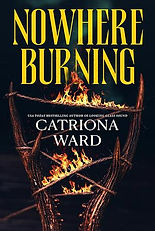
Catriona Ward is one of the most unique voices in horror and her latest novel Nowhere Burning is another stunning example of what sets her apart. Like many of Ward’s novels, Nowhere rests on the perspective of an adolescent. In this case, the story primarily revolves around Riley, a teenager living with her much younger brother Oliver in the home of a distant uncle they call Cousin. The siblings were taken in by Cousin after bouncing between foster homes in the wake of their mother’s death. They found their relief quickly extinguished after realizing that, despite being “family,” Cousin’s home was worse than any of the previous placements. When a mysterious invitation to run away to Nowhere (a fabled abandoned ranch formerly owned by an elusive movie star, and now said to be overtaken by youth who have fled their own Cousin-esque homes to form a Lost Boys type commune) Riley seizes it. Trekking into the Rocky Mountains with Oliver in tow, Riley has the grit to survive the journey, but what she finds at Nowhere is a whole new kind of threat to their survival. Ward’s book draws comparisons to Lord of the Flies, Showtime’s Yellowjackets, and of course Peter Pan. I agree with all of these, but there’s something softer in there, too. Riley and Oliver’s plight hit nostalgic notes that resonated with my childhood self, reading books like From the Mixed-Up Files of Mrs. Basil E. Frankweiler and Bridge to Teribithia. Nowhere Burning paints a picture of loneliness and vulnerability in juxtaposition to the feral and frightening, which makes the violence and desperation the characters encounter that much more gut-wrenching. It lays the queasy underbelly of Grimm’s grimmest fairytales against the resilient backbones of the Boxcar Children. The best children’s stories, the ones that are honest and unflinching, understand that growing up happens in ways and at speeds that can’t be predicted. Childhood and adolescence can be a trial by fire, a car crash- something that happens to you, without your control or consent. Kids who come out the other side of growing up equipped with remarkable self-sufficiency, determination, strength and resourcefulness might have had excellent guidance and support, but just as often their enviable traits are born from necessity. The fighters, the persevering, the never-give-ups, and the just-watch-me’s are formed when a child is dependent on adults who are none of those things and worse. Because they know no one is coming to save them and surviving means getting smart and strong, fast. Nowhere Burning isn’t a story for children, but it is a children’s story, and a powerful one. The psychological horror novel unfolds in multiple viewpoints. Readers may question the loose or unknown connections between characters, but as the book progresses, the ties between characters and their narratives tighten. Each point of view is like a thread carrying all the feelings and experience of its narrator, and by the end when they've unspooled and knotted together, the reader is caught off guard, snatched up in a complex net of expertly woven emotion. Ward’s writing extends above and beyond what many literary readers might expect from the horror genre. I would encourage anyone interested in examining how identity forms within complicated and dysfunctional family relationships, what it looks like to search for belonging in a found family, and how these families can both raise and bury you to give this one a read. Thank you to the publisher, Tor, for providing this book for review consideration via NetGalley. All opinions are my own. Rating: 4.5/5 for characters I cared about, a surprise I didn’t see coming, packing in a whole rollercoaster of feelings, and also packing in just about every horror element (ghosts, secret passage ways, hallucinations, feral children, dangerous environments, creepy cult figures). Content warnings: Violence, child abuse, religious abuse, domestic violence, drug use, kidnapping.
ISBN/UID: B0DDJB56J8
Format: Digital
Original Pub Year: 2026
Edition Pub Date: 24 Feb 2026
Publisher: Tor Nightfire
Netgalley ARC
Dark Sisters
Kristi Demeester

Kristi Demeester’s feminist horror novel Dark Sisters spans more than 250 years, time-hopping between 1751, 1953, and 2007 to show that the more things change, the more they stay the same. The story opens on Anne Bolton, a widowed woman skilled in plant medicine and accused of witchcraft. Her connection to the earth and ability to render healing treatments from its properties, alongside her lack of husband, leads to accusations of witchcraft. Anne and her daughter Florence, a young woman with more christian leanings, flee their village and are later joined by several others seeking a different way of life. The violent rift between Anne and her community created by their patriarchal religious intolerance becomes more personal when Florence’s own fervor for condemning her mother grows. The dreadful fate of mother and daughter is the catalyst for a generational curse. The history and impact of the “Dark Sisters,” the story of whom is used as an allegory, a sleepover story, and a veiled threat, unfolds through alternating narrators. We follow the life of Mary Shepard in the 1950’s, a reverend’s wife attempting to be the perfect homemaker and ideal mother, while also trying (unsuccessfully) to repress her sexuality, with devastating results. In 2007, teenager Camilla questions the confines of her strict religious community and resolves to uncover the truth of why women in her community are afflicted with a mysterious illness and how to stop it. The book weaves together the experiences of each narrator in tandem and smoothly flows between eras. The result is a tapestry depicting centuries of women whose power has been exploited and whose lives have been controlled by the men in their society, under the guise of holiness. Demeester does well differentiating the voice and tone between narrators in their respective time periods. It’s clear who the focus is on in each section and each storyline has unique and compelling plotpoints. My only criticism is that the sections narrated by Camilla have more of a YA feel, whereas the rest reads as an adult novel. For the most part, the historical sections taking place in the 1950’s and 1750’s hold more emotional complexity and relational depth, which does align with the ages and stages of the sections’ narrators, so it isn’t unfitting. Fortunately, as Camilla’s experience in 2007 evolves, so does her character, becoming her own force of nature like the women before her. Several content warnings to consider: self-harm, coercion, abuse, sexual abuse and assault, suicide, hatred/bigotry/homophobia, and violence. The final chapter was my favorite, and also the most graphic, shifting the story’s tone in a powerful way. I’ve found it difficult to decide if this felt abrupt and the story may have benefitted from sprinkling some of the intensity throughout, or if it was the perfect gut punch ending- either way, it was impactful enough that I’m still thinking about it. (Thank you to the publisher for providing this book for review consideration via NetGalley. All opinions are my own.)
ISBN/UID: 9781250286819
Format: Digital
Original Pub Year: 2025
Edition Pub Date: 09 Dec 2025
Publisher: St. Martin's Press
Netgalley ARC
Sweetside Motel
E.L. Chen

The Sweetside Motel is a deceptively short read that explores the horrors of abusive relationships and the ghosts left behind in the wake of unresolved trauma. Sarah Ng is a twenty-something freelance writer living with her boyfriend in a tiny Toronto apartment when the Covid-19 pandemic hits. Her access to the outer world had already been dwindling due to the isolation of an abusive relationship, and when lockdown sparks the tension between them, it causes a violent implosion. Sarah flees Toronto, hoping to leave her past and her boyfriend behind her, but finds herself quickly stranded in a rural town whose inhabitants have aggressive opinions on how to handle the pandemic and bigoted beliefs about who spread the virus. She is taken in by two brothers whose family history both binds them to the town and casts them as outsiders, and who invite her to stay at their inn- The Sweetside Motel, or “suicide motel” to the locals. Cramped together in a house haunted by family ghosts and surrounded by sinister forest, Sarah finds herself questioning her judgement, her idea of right and wrong, and her sense of self. Chen’s characters are well-developed, considering the story’s length, and though there are some areas that could have been explored more deeply (Sarah’s own childhood? Mrs. Vass? The town’s reaction to Uncle Isaac’s pandemic control?) for the most part, the lack of clarity and loose strings contribute to the overall sense of open-ended dread. The first and last chapter of Sweetside Motel essentially function as a prologue/epilogue, and the change in POV in these chapters seems unnecessary. The final chapter is lovely and a satisfying ending, however the first feels like forced tension, whereas the rest of the story has more nuanced and atmospheric tension building. Chen compresses layers of external tension surrounding the pandemic between layers of internal fear, grief, and confusion. The result is a dark novella where each turn of the page is like tossing a twenty-sided die that exposes a new facet of domestic violence each time it lands. For readers who might be unacquainted with abusive relationships in real life, this is a quick and engaging thriller. For readers that resonate with Sarah, Caleb, or Elijah’s pasts, the story might take a larger emotional toll. Thank you to NetGalley for the ARC!
ISBN/UID: 9781953736529
Format: Digital
Original Pub Year: 2026
Edition Pub Date: 02 Mar 2026
Publisher: Interstellar Flight Press
Netgalley ARC